
Prepared by Laura Kešytė.
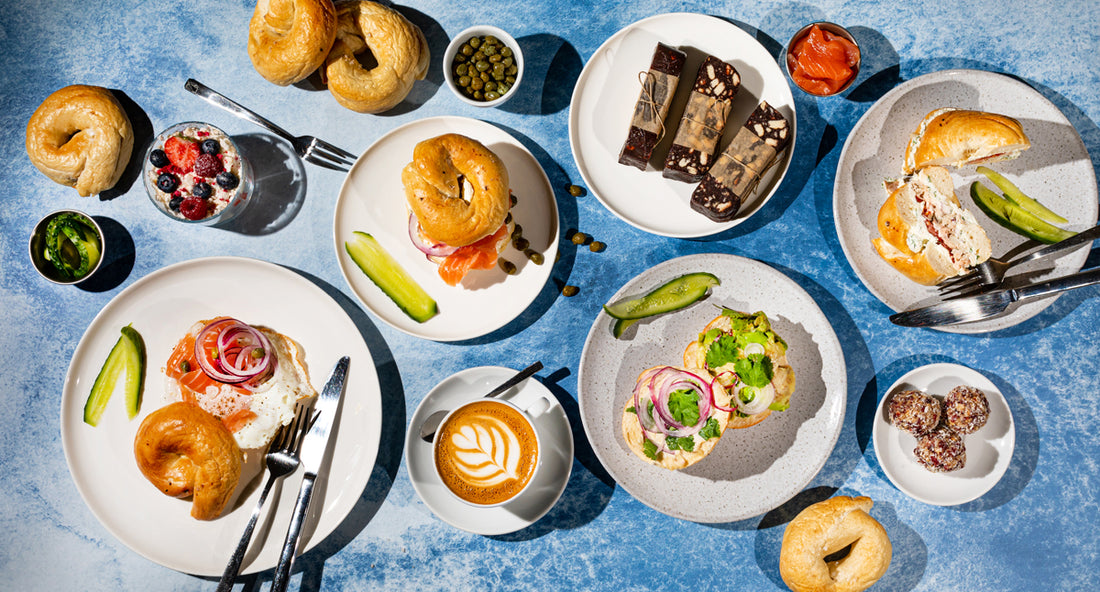
In the capital, opposite the Jewish synagogue, there is a place where once a week, on Friday, you can taste freshly baked "Atlanto Beygels". Vilnius residents snap them up from morning, so arriving in the afternoon is too late. The secret to these bagels is their unique taste and texture. It is achieved by combining a centuries-old Jewish recipe with modern New York-style classics.
In the small kitchen of the "Coffee Spells" coffee shop, breakfast and lunch are prepared daily, and bread and desserts are baked in the local oven. The bluish and greenish shades of the cafe's interior, preserved since the beginning of the last century, are also characteristic of the interior color scheme of the synagogue opposite.

"Perhaps there's also a coincidence that these colors resonate so well together. Before the war, this complex of buildings, at the intersection of Pylimo and Ligoninės streets, housed a Jewish hospital," says Aistė Košienė, the manager of the coffee shop. Although the place itself does not belong to a Jewish family, it seems that the historically established atmosphere of the Jewish quarter naturally inspires Jewish culinary experiences.
Here, coffee is brewed from the rarest coffee beans, roasted by "Crooked nose & coffee stories," and "Atlanto Beygels" are baked on Fridays. "For all our visitors, Friday is like a small celebration, and it has been for a year now. Atlanto bagels are valued because they are different. They are moister, differ in color and size. Even their method of twisting is unique," says A. Košienė.
A bun with an incredible history
Many probably already know that a bagel is a Jewish bun with a hole, made from yeast dough. This centuries-old pastry has witnessed many changes in eras and, incidentally, was born in these lands. It is first mentioned in history in Krakow – a city where, during the Polish-Lithuanian Commonwealth, Lithuanian and Polish rulers were crowned.

Four hundred years ago, only aristocrats could eat bagels. White flour at that time cost 4 to 5 times more than rice; it was not as accessible to many as it is today. Thus, even local Jewish communities would only make them for special occasions.
However, a few centuries later, bagels began to be sold everywhere – in Polish markets and on city streets. The geography of this dish expanded even more when some Jewish families emigrated to Great Britain and the USA. Here, the buns with a hole quickly became popular street food.
True, after tragic events on the continent, the bagel disappeared from the Eastern European map for a long time. Only after the "iron curtain" opened did these Jewish pastries begin to be sold in Warsaw, Prague, and Budapest. In this region, the Bagel became a New York breakfast dish – a symbol of Western life from across the Atlantic (or an emigrant who, after long wanderings, returned home but... in a slightly different garment).
Bagel renaissance in Vilnius
It was "Atlanto Beygels" (more precisely, their "rehearsal," as this name had not yet been conceived at the time) that were the first to bring bagels back into the culinary vocabulary of Lithuania, primarily Vilnius. This happened through the initiative of three friends – Menachem Kaiser, Jake Levine, and Elena Narbutaitė, who joined them along the way. In 2010, they organized a bagel tasting party in one of the capital's restaurants, whose echoes caught the attention of foreign media.
Indeed, learning to properly prepare a bagel was no easy challenge. Unlike ordinary baked goods, a bagel bun is first blanched in water and only later put into the oven. In addition, it gains its variety of flavors due to a special preparation technology: the kneaded dough is left to "rest" in a cool place, which stimulates the formation of lactic acid bacteria. This trick gives the bagel two qualities – a mild acidic taste and a crispy crust.

"Our bagel is quite moist; when bitten, the dough is slightly sticky. Its size is medium, neither too small nor too large. The bagel is sprinkled only with coarse salt, served in classic ways with several types of cream cheese, with cream cheese and salmon, mackerel or herring, with butter and a fried egg. There is also a vegan option, which can outshine all the above," says Elena.
By the way, freshly roasted coffee pairs perfectly with bagels. "I invite you to taste single-origin coffee, brewed from Brazilian beans. You can taste nuts and chocolate in them – it's like a dessert that goes very well with a bagel, usually eaten in the first half of the day," recommends A. Košienė, the manager of "Coffee Spells."